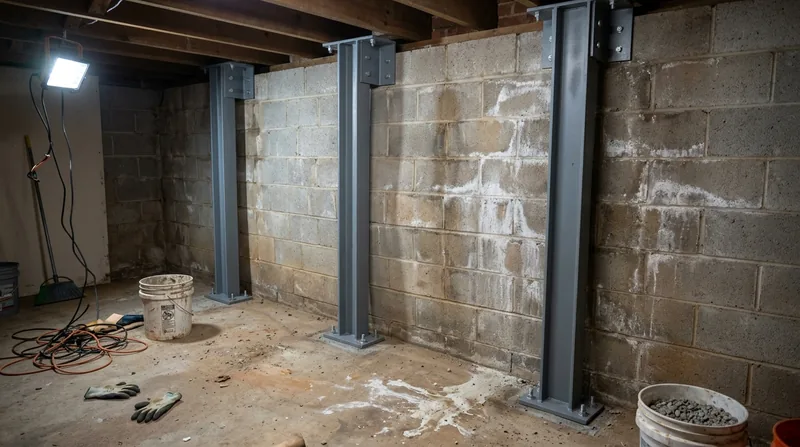




When a basement wall starts to lean inward, the cause is almost always outside the house: hydrostatic pressure from saturated Piedmont clay pushing against old brick, block, or poured concrete. If you are searching for Bowing Wall Repair in Charlotte, you need a contractor who reads the soil and the wall together, not one who sells a single fix for every job. Charlotte sits on deep red clay and weathered granite, with shrink-swell pockets that load and unload foundation walls with every wet and dry cycle. The older bungalows and Tudor Revival homes in Dilworth, Plaza Midwood, and Elizabeth carry full basements with brick foundation walls that were never designed for today's storm intensity. Newer walkout basements in Waxhaw and Huntersville sit on sloped lots where hillside runoff adds to the load. We stabilize bowing walls with carbon fiber straps, steel I-beams, or wall anchors matched to the severity of the movement and the soil behind the wall. Start with a free basement inspection so we can measure the bow before anything is specified.
Why Bowing Walls Show Up in Charlotte's Clay and Older Brick Foundations
Charlotte's dominant failure mode is hydrostatic pressure against basement walls after long wet spells. The clay here holds water, expands, and pushes inward, and the high water table after summer thunderstorms and tropical remnants keeps the soil loaded for days. Old brick and stone foundation walls in Myers Park, Eastover, and Cotswold were laid with lime mortar that softens when saturated, so they bow before they crack. Hillside lots near Little Sugar Creek and McAlpine Creek add runoff that compounds the load. The wall tells you which force is winning by where the movement shows.
- Horizontal cracking near the middle of the wall usually means backfill pressure and clay swell are driving the bow.
- Stair-step cracking at the corners points to differential settlement, not just pressure.
- Efflorescence and white staining show water is moving through the wall and evaporating on the inside face.
- Inward lean at the top with a tight base often means the floor joists are holding the wall while the middle pushes in.
We measure the bow, check the mortar joints, and look at the grading and downspouts before we recommend a repair method.
Key info: A 1920s brick bungalow off Central Avenue in Plaza Midwood had a rear basement wall bowed about 2 inches at mid-height after a wet spring. The cause was a downspout dumping at the corner and clay that never dried out. Carbon fiber straps stabilized the wall, and extending the downspout removed the source.
Permits for structural foundation repair vary by jurisdiction, so confirm requirements with the City of Charlotte before work begins.
How We Diagnose and Stabilize a Bowing Wall in Charlotte
We do not quote a bowing wall from a photo. The first step is a site visit that reads the wall, the soil, and the water together, because a strap on a wall that is still taking water is a temporary fix. We check the bow with a plumb line and a level, map the cracks, and test the mortar. Then we look at the grade, the downspouts, and the drain tile at the footing to see where the water is coming from. Only after that do we match the repair to the movement.
- We measure the inward movement at the top, middle, and base of the wall and record it for comparison later.
- We inspect the footing drain and interior perimeter drain to see whether water is being managed or left to load the wall.
- We check the grading and downspout extensions, since roof water dumped at the foundation is a common driver in Charlotte.
- We recommend carbon fiber straps for moderate bow, steel I-beams for heavier load, or wall anchors where the soil allows an outside tieback.
- We correct the water source with foundation waterproofing so the repair is not fighting a wet wall.
Every repair ends with a written record of the starting measurement so you can see the wall is stable at the next inspection.
Key info: A 1960s brick ranch in Matthews had a block basement wall bowing under a hillside that drained toward the house. We installed steel I-beams on 4-foot centers and tied the wall back, then added a French drain on the uphill side to cut the pressure at the source.
Bowing Wall Repair Methods We Use in Charlotte
The right method depends on how far the wall has moved, what the wall is made of, and how much room you have outside. A brick wall in Dilworth and a poured wall in Ballantyne do not fail the same way, and the repair should not be the same either. We match the method to the wall, not to a package price.
| Approach | Description | Best for |
|---|---|---|
| Carbon fiber straps | Straps bonded to the inside face and anchored top and bottom to stop further bow. | Moderate bow in block or poured walls with sound mortar. |
| Steel I-beams | Vertical beams set against the wall and tied into the floor and joists. | Heavier load and larger movement in clay soil. |
| Wall anchors | Outside anchor plates tied through the wall to inside plates to pull it back. | Walls with accessible outside soil and room for anchor plates. |
| Epoxy or polyurethane injection | Resin injected into cracks to seal them and restore some structural continuity. | Crack sealing where the wall is not bowing, paired with pressure relief. |
We pair every structural repair with a water fix, because a stabilized wall that still takes water will keep moving.
Bowing Wall Repair Cost in Charlotte: What to Expect
Bowing wall repair is priced by the linear foot of wall and the method, not by the hour. A single wall with moderate bow and carbon fiber straps is a different job from a full basement with steel I-beams on both long walls. We start carbon fiber strap work from $600, and that figure reflects a small, accessible section with the water source already under control. Larger jobs move up with the number of straps, the beam spacing, and whether the footing drain needs work. Getting two or three estimates is smart, and so is asking each contractor how they measured the bow and what they plan to do about the water. Our pricing overview lays out the ranges so you can compare like for like.
Bowing Wall Repair Near Me: How to Choose a Contractor Near Charlotte
Ask for the license and insurance certificate before anyone walks the basement, and confirm the policy covers structural work, not just general handyman tasks. Get at least two written estimates that state the method, the measurement of the bow, and what happens to the water. Ask for references from jobs in older Charlotte neighborhoods with brick foundations, because those walls behave differently from new poured concrete. Confirm who pulls the permit if structural repair is required, and check any HOA rules before exterior anchor work. You can request a free estimate and we will walk the wall with you.
If the wall is still moving and water is still loading it, the repair is not finished. We fix both, and we tell you plainly when crack sealing alone is enough.
Bowing Wall Repair in Charlotte: Pricing Guide
| Service | Price | Details |
|---|---|---|
| Carbon fiber strap repair, small section | Starting at $600 | Covers a limited wall section with moderate bow and sound mortar joints. |
| Carbon fiber strap repair, full wall | Starting at $1,800 | Multiple straps across one wall, priced by linear feet and strap spacing. |
| Steel I-beam stabilization | On estimate | Heavier load and larger movement need an on-site look at beam spacing and tie-in. |
| Wall anchor system | On estimate | Requires accessible outside soil and anchor plate placement, so it is quoted after a site visit. |
| Travel | Included | In Charlotte and surrounding areas, no separate call-out or mileage fee. |
| Estimate | Free | Response within 24h at (980) 272-4046, no obligation to book. |
Indicative pricing, the exact cost depends on square footage, finish, and site access. Free personalized estimate within 24h at (980) 272-4046.


