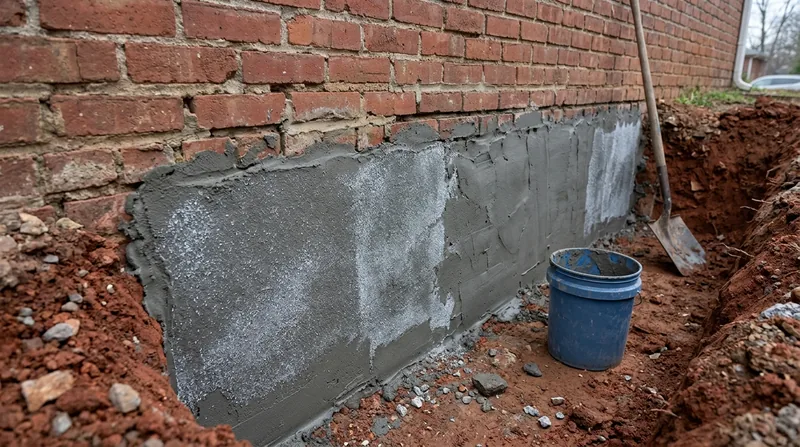




Charlotte sits on the Piedmont, where deep red clay, weathered granite and pockets of shrink-swell soil hold water against foundation walls long after a summer storm has passed. That is why Foundation Waterproofing in Charlotte looks different here than it does in northern cities. We work on 1920s brick bungalows in Plaza Midwood and Elizabeth with soft mortar joints, on Tudor Revival and Colonial Revival homes in Myers Park and Dilworth with old stone and brick footings, and on 1990s-and-newer brick homes in Ballantyne and Huntersville where lots slope toward creeks. Most of our work is below grade: crack repair, wall sealing, drainage correction and footing drain repair matched to the foundation you actually have. If you are seeing water after rain, efflorescence or a musty smell, start with a free basement inspection so we can trace where the water is entering before anyone quotes a repair.
Why Foundation Waterproofing Matters in Charlotte's Clay and Creek-Bottom Lots
Charlotte gets heavy summer thunderstorms and the rain bands of tropical remnants, and the ground here does not drain like sandy coastal soil. Red clay and weathered gneiss shed water slowly, so the water table rises fast after a wet spell and hydrostatic pressure builds against basement walls. Add shrink-swell clay that opens and closes cracks seasonally, and you get the failures we see most: wall seepage after rain, white efflorescence bloom, and water pushing through cold joints on poured walls.
- Old brick and stone foundations in Dilworth and Eastover wick moisture through mortar and need repointing and parging before any coating.
- 1950s and 1960s brick ranches in Sedgefield and Cotswold often have daylight basements where hillside runoff collects at the rear wall.
- Newer homes near Little Sugar Creek and McAlpine Creek sit on low spots where the water table stays high for days after a storm.
- Poured-concrete walkouts in Huntersville and Mooresville show hairline shrinkage cracks that leak under pressure but look harmless from inside.
None of this is unusual for the region, and none of it fixes itself once the clay dries out in July.
Key info: On a 1930s brick bungalow off Central Avenue in Plaza Midwood, the leak was not a crack at all. The original footing drain had silted shut, so water stood against the wall and found the mortar. Sealing the wall alone would have failed within a season.
Permits for structural foundation repair and drainage work vary by jurisdiction, so confirm requirements with the Mecklenburg County building department before work begins.
How We Approach Foundation Waterproofing in Charlotte, Step by Step
We start below grade and work outward from the actual source of the water. A moisture meter and a visual walk of the interior perimeter tell us whether the problem is a single crack, a failed coating, or hydrostatic pressure that needs drainage. We match the method to the foundation type: epoxy or polyurethane injection for poured walls, repointing and parging for old brick, dimple board and membrane where exterior access makes sense.
- We inspect the basement, the exterior grade and the downspout discharge to find where water is entering.
- We map cracks, cold joints and efflorescence and test whether they are active during or after rain.
- We recommend the least invasive fix that actually addresses the cause, and we say plainly when simple crack sealing is enough.
- We correct grading and downspout extensions so roof water stops landing at the foundation.
- We install the chosen repair, from injection ports and epoxy to interior perimeter drain and sump basin where pressure demands it.
Every job ends with a walkthrough so you understand what was done and what to watch for in the next wet season.
Key info: A split-level in Matthews had water crossing the basement floor after every storm. The crack was minor; the real issue was a clogged footing drain and a downspout dumping at the corner. We cleared the drain, extended the downspout and sealed the crack, and the floor stayed dry through the next tropical remnant.
If the diagnosis points to perimeter drainage rather than a crack, the work moves to our interior drain tile system page.
Foundation Waterproofing Methods We Use on Charlotte Foundations
There is no single product that suits every wall. Old brick needs a breathable approach so trapped moisture does not spall the face, while poured concrete takes injection and crystalline treatments well. The table below shows how we match method to foundation type and failure mode.
| Approach | Description | Best for |
|---|---|---|
| Epoxy injection | Ports drilled along the crack, resin injected to fill and bond the break. | Non-moving cracks in poured concrete walls. |
| Polyurethane injection | Flexible foam expands into the crack and seals active leaks. | Active leaks and cracks that move seasonally. |
| Parging and repointing | Mortar repaired and wall face coated to shed water. | Old brick and stone foundations in Plaza Midwood and Elizabeth. |
| Membrane and dimple board | Waterproof membrane applied to the exterior wall face with drainage board. | Exterior access jobs where soil pressure is the main driver. |
| Interior perimeter drain | Drain tile at the footing inside the basement, leading to a sump basin. | Hydrostatic pressure and high water table lots near creeks. |
We choose the method after inspection, not before, because the wrong approach on old brick can do more harm than the leak.
Foundation Waterproofing Cost in Charlotte: What to Expect
Most foundation waterproofing work in Charlotte starts around $3,500, and that figure covers a defined scope rather than an open-ended repair. A single active crack with injection and grading correction sits near that starting point. A full interior perimeter drain with sump basin on a creek-side lot in Matthews or Mint Hill runs higher because of excavation, pump equipment and discharge routing. Old brick foundations that need repointing before sealing add labor.
- Access matters: a basement wall crowded by HVAC equipment or finished framing slows the work.
- Foundation type sets the method, and old stone or brick costs more to prep than poured concrete.
- Water table and lot slope near Little Sugar Creek or McAlpine Creek can require drainage, not just sealing.
- Discharge routing for a sump pump may need a permit, which adds a step to the schedule.
Get two or three written estimates and compare scope line by line, not just the bottom number. Our full pricing overview breaks down what each scope includes.
Choosing a Foundation Waterproofing Contractor Near Me in Charlotte
Ask for the license and insurance certificate before anyone walks the basement, and confirm the policy covers below-grade work. Ask how the contractor diagnoses the leak: if the answer is a coating without a moisture reading, keep calling. Ask for references from homes of similar age and foundation type, because a fix that works on a 2005 poured wall may fail on a 1935 brick wall in Dilworth.
- Confirm the contractor is licensed and insured and can produce a certificate on request.
- Get at least three estimates and make sure each one states the diagnosis and the method.
- Check references for jobs done at least one wet season ago, not last month.
- Ask who pulls any permit required for structural repair or sump discharge.
- Check HOA rules in subdivisions like Ballantyne or Huntersville before exterior work changes grade or discharge.
When you are ready to talk through your basement, contact us and we will schedule a free inspection.
Foundation Waterproofing in Charlotte: Pricing Guide
| Service | Price | Details |
|---|---|---|
| Crack injection and sealing | Starting at $3,500 | Includes crack mapping, epoxy or polyurethane injection and grading correction; foundation type drives the price. |
| Wall sealing and parging | Starting at $4,200 | Covers surface prep, repointing and breathable coating; old brick and stone add labor. |
| Interior perimeter drain with sump | Starting at $7,500 | Includes drain tile, sump basin, pump and discharge routing; water table and lot slope raise it. |
| Exterior membrane and drainage | On estimate | Excavation depth, soil conditions and access decide the number, so we look on site first. |
| Travel | Included | in Charlotte and surrounding areas, no separate call-out or mileage fee |
| Estimate | Free | Response within 24h at (980) 272-4046, no obligation to book |
Indicative pricing, the exact cost depends on square footage, finish, and site access. Free personalized estimate within 24h at (980) 272-4046.


